

Medically reviewed by Dr. S. D. Shamsundar, Radiation Oncologist, Precision Oncology Clinic, Bangalore
Being told that you may need radiation therapy can naturally bring many questions.
One of the most common questions patients ask is:
“Will radiation therapy hurt?”
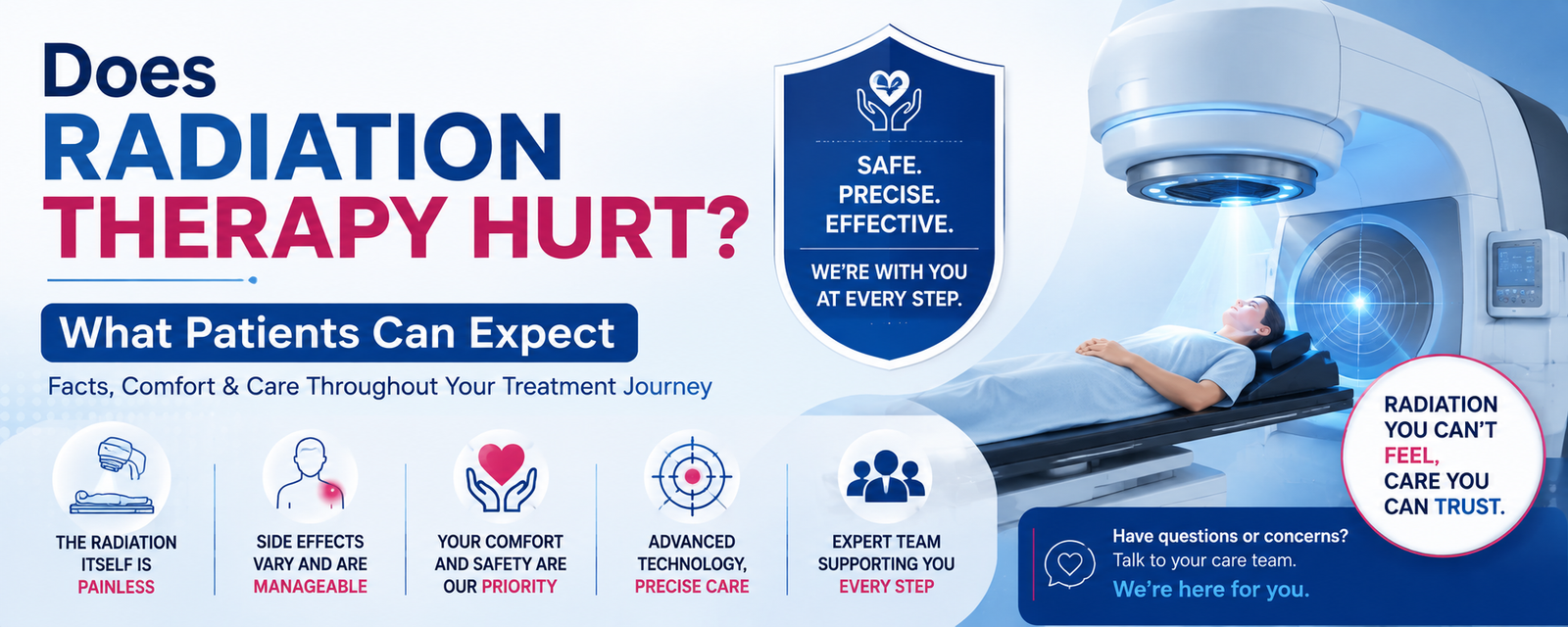
The short answer is that external-beam radiation therapy itself is generally painless and cannot usually be felt while the radiation is being delivered. The machine does not touch the body, although staying still in a particular position during treatment may sometimes feel uncomfortable.
However, radiation therapy can cause side effects because radiation can also affect some healthy cells near the treatment area. These side effects vary depending on the part of the body being treated, the radiation dose, the treatment technique and whether radiation is combined with other treatments.
Understanding what to expect can make radiation treatment feel much less frightening.
What Does Radiation Therapy Feel Like?
During external-beam radiation therapy, you usually lie on a treatment couch while the radiation machine delivers carefully planned radiation to the treatment area.
The machine may move around you during treatment, but it does not normally touch your body and the radiation itself cannot be felt. You may hear sounds from the machine while it is operating.
The treatment team usually leaves the treatment room during radiation delivery, but they can see and communicate with you throughout the session.
The treatment itself is generally short, although the preparation and positioning can take longer.
So, does the radiation burn or sting?
No.
Radiation therapy does not normally feel like an injection, electrical shock or burning sensation while the radiation is being delivered.
Any discomfort that develops is generally related to the side effects of treatment, rather than the sensation of the radiation itself.
Why Can Radiation Therapy Cause Discomfort?
Radiation is designed to damage cancer cells, but nearby healthy cells can also be affected.
When healthy tissue is affected, patients may develop side effects.
The type and severity of side effects depend on:
- The area being treated
- The size of the treatment area
- The total radiation dose
- The number of treatment sessions
- The type of radiation therapy
- Whether chemotherapy or another treatment is given at the same time
- Individual patient factors
Not everyone experiences the same side effects. Some patients have only mild symptoms, while others may experience more significant effects.
Common Radiation Therapy Side Effects
1. Tiredness or Fatigue
Fatigue is one of the most common side effects associated with radiation therapy.
You may feel:
- More tired than usual
- Less energetic
- The need to rest more frequently
- Tiredness that increases as treatment progresses
Fatigue may continue for a period after treatment finishes.
It can also be influenced by the cancer itself, other treatments, travel to treatment appointments, stress and changes in sleep.
What can help?
Try to:
- Prioritise rest
- Maintain gentle physical activity if your doctor says it is appropriate
- Eat nutritious meals
- Stay adequately hydrated
- Ask your treatment team if fatigue becomes difficult to manage
2. Skin Changes
Radiation therapy can cause changes to the skin in the area being treated.
Depending on the treatment, you may notice:
- Redness
- Darkening of the skin
- Dryness
- Itching
- Soreness
- Peeling or irritation
These changes may develop gradually during treatment rather than immediately after the first session.
Skin reactions usually improve after treatment, although the recovery period can vary between patients and treatment areas.
Important:
Do not apply creams, lotions or other products to the treatment area without asking your radiation oncology team what is appropriate for your specific treatment.
3. Hair Loss in the Treatment Area
Radiation therapy can cause hair loss in the area receiving radiation.
For example:
- Head radiation may cause hair loss on the scalp.
- Radiation to another body area may affect hair only in that treatment field.
Whether the hair grows back depends on the radiation dose and treatment area.
4. Soreness or Pain
Radiation therapy can sometimes cause soreness or pain, but this depends strongly on the area being treated.
For example:
- Radiation to the head and neck may cause a sore mouth or throat.
- Radiation to the chest may cause discomfort or swallowing difficulties.
- Radiation to the abdomen or pelvis may cause abdominal discomfort or bowel-related symptoms.
- Radiation to the skin can cause soreness in the treatment area.
Pain can also occur because of the cancer itself.
Your radiation oncology team can recommend appropriate ways to manage pain and other treatment-related symptoms.
Does Radiation Therapy Hurt More as Treatment Continues?
Not necessarily, but some side effects can develop gradually and become more noticeable as treatment progresses.
Radiation affects cells over time, so symptoms such as fatigue and skin irritation may not appear immediately.
For many patients, side effects gradually improve after treatment ends, although the recovery period depends on the treatment area and individual circumstances.
This is why your radiation oncology team monitors you throughout your treatment rather than waiting until the end.
Does Radiation Therapy Hurt During Every Session?
Usually, the radiation delivery itself does not hurt.
You may need to lie in a particular position and remain still while the treatment is delivered. If you already have pain, stiffness or difficulty maintaining a particular position, this can sometimes make the treatment session uncomfortable.
Tell your radiation therapy team if you are having difficulty lying in position.
They can assess the problem and determine how best to make you more comfortable.
Does Radiation Therapy Make You Radioactive?
For most patients receiving external-beam radiation therapy, the treatment does not make you radioactive.
Once the treatment session is over, you can generally be around other people, including family members.
This is different from certain forms of internal radiation therapy, where specific safety precautions may sometimes be required depending on the treatment.
Your radiation oncologist will explain any precautions that apply to your particular treatment.
What About Advanced Radiation Therapy?
Modern radiation therapy uses detailed imaging, treatment planning and advanced techniques to deliver radiation as accurately as possible.
Depending on the cancer and clinical situation, radiation therapy may include techniques such as:
- 3D Conformal Radiation Therapy (3D-CRT)
- Intensity-Modulated Radiation Therapy (IMRT)
- Image-Guided Radiation Therapy (IGRT)
- Volumetric Modulated Arc Therapy (VMAT)
- Stereotactic Radiosurgery (SRS)
- Stereotactic Body Radiation Therapy (SBRT)
The goal is to deliver the prescribed radiation dose to the cancer while limiting unnecessary exposure to surrounding healthy tissue.
The most appropriate technique depends on the cancer type, location, stage and individual treatment plan.
Can Radiation Therapy Be Used to Relieve Pain?
Yes.
Radiation therapy is not used only to treat cancer with the aim of cure. In certain situations, it can also be used as palliative treatment to relieve symptoms.
For example, radiation can be used to help control pain caused by cancer that has spread to the bones.
In some situations, patients may experience a temporary increase in pain after treatment before improvement occurs. Your cancer care team can provide appropriate medication and supportive treatment when needed.
What Happens Before Radiation Therapy?
Radiation treatment usually involves careful planning before the first treatment session.
Your radiation oncology team may perform:
1. Consultation
Your radiation oncologist reviews your diagnosis, scans, pathology and previous treatments.
2. Treatment planning
Imaging is used to identify the area that needs treatment and the surrounding organs that need protection.
3. Simulation
You may be positioned in the same way that you will be positioned during treatment.
4. Treatment planning
A personalised radiation plan is created based on your cancer and anatomy.
5. Treatment delivery
Radiation is then delivered according to the prescribed treatment plan.
The exact process varies depending on the cancer and radiation technique.
How Can Patients Manage Radiation Therapy Side Effects?
There is no single strategy that works for everyone.
Your treatment team may recommend:
- Adequate rest
- Nutritious food
- Sufficient fluids
- Appropriate skin care
- Medicines for pain or nausea when required
- Nutritional support
- Mouth and dental care for some head and neck treatments
- Exercise or activity appropriate to your condition
Most importantly, tell your radiation oncology team about new or worsening symptoms.
You do not have to simply tolerate significant discomfort in silence.
When Should You Contact Your Radiation Oncology Team?
Contact your treatment team if you experience symptoms that are severe, worsening or difficult to manage.
Depending on the treatment area, this may include:
- Significant pain
- Severe skin reactions
- Difficulty eating or drinking
- Difficulty swallowing
- Persistent vomiting
- Severe diarrhoea
- Significant weakness
- Breathing difficulties
- Fever or signs of infection
- Any symptom that concerns you
Your treatment team can determine whether the symptom is an expected side effect or requires additional evaluation.
Is Radiation Therapy Safe?
Radiation therapy is a carefully planned cancer treatment.
Modern radiation oncology aims to deliver radiation accurately to the tumour while reducing exposure to nearby healthy tissues as much as reasonably possible.
However, like all cancer treatments, radiation therapy has potential risks and side effects.
Your radiation oncologist should explain the expected benefits, possible short-term effects and potential long-term risks before treatment begins.
Dr. S. D. Shamsundar – Radiation Oncologist
Dr. S. D. Shamsundar is a Radiation Oncologist at Precision Oncology Clinic, Bangalore.
Radiation oncology involves the use of radiation to treat cancer, either as a primary treatment or in combination with other cancer therapies.
Depending on the cancer type and stage, radiation therapy may be used:
- Before surgery
- After surgery
- Alongside chemotherapy or systemic therapy
- As the main treatment for selected cancers
- To control symptoms in advanced cancer
The treatment approach is individualised according to the patient’s diagnosis, cancer stage, tumour location and overall health.
The Bottom Line: Does Radiation Therapy Hurt?
The radiation itself is generally not painful during external-beam treatment.
What patients may experience are side effects that develop during or after treatment. These can include tiredness, skin changes, soreness and symptoms specific to the area being treated.
Every patient responds differently.
The important thing is to communicate openly with your radiation oncology team. Most side effects can be anticipated, monitored and managed appropriately.
Radiation therapy is designed not only to treat cancer, but to do so as precisely and safely as possible.
If you have been advised to undergo radiation therapy, understanding your treatment plan can help reduce anxiety and prepare you for the treatment journey.
Frequently Asked Questions
1. Does radiation therapy hurt?
External-beam radiation therapy itself is generally painless. The machine does not touch the body and the radiation cannot usually be felt. However, side effects such as skin irritation, soreness or fatigue may develop during or after treatment.
2. What does radiation therapy feel like?
Most patients do not feel the radiation itself. You may hear sounds from the treatment machine and need to remain still in a particular position during treatment.
3. Does radiation therapy burn the skin?
Radiation can cause skin reactions in the treatment area, including redness, darkening, dryness or soreness. These reactions usually develop gradually rather than immediately.
4. Does radiation therapy cause pain?
Radiation therapy can cause soreness or pain depending on the treatment area and the type of cancer being treated. Pain can also be caused by the cancer itself. Tell your treatment team about any pain so it can be managed appropriately.
5. Does radiation therapy hurt more than chemotherapy?
Radiation therapy and chemotherapy affect patients differently, so there is no universal comparison. Radiation side effects are often related to the area being treated, while chemotherapy can cause different systemic side effects.
6. Will I feel sick after radiation therapy?
Some patients experience nausea, but it depends on the area being treated and the treatment plan. Your radiation oncology team can prescribe medication when appropriate.
7. Does radiation therapy make you radioactive?
External-beam radiation therapy does not generally make you radioactive. Special precautions may apply to some forms of internal radiation therapy.
8. How long do radiation therapy side effects last?
Many side effects improve gradually after treatment ends, but the duration varies depending on the treatment area, radiation dose and individual patient. Some side effects can last longer or occasionally become long-term.
9. Can radiation therapy reduce cancer pain?
Yes. Radiation can sometimes be used to relieve pain and other symptoms caused by cancer, including pain from cancer that has spread to the bones.
10. What should I do if radiation therapy side effects become difficult?
Tell your radiation oncology team. They can assess your symptoms and recommend appropriate medicines, skin care, nutritional support or other measures to help manage side effects.
Book a Radiation Oncology Consultation in Bangalore
If you have been advised radiation therapy or want to understand whether radiation treatment may be appropriate for your cancer, speak with a qualified radiation oncologist.
Dr. S. D. Shamsundar
Radiation Oncologist
Precision Oncology Clinic, Bangalore
Book an Appointment: +91 95915 35454
Medical Disclaimer
This article is intended for general cancer education and awareness. It does not replace medical consultation, diagnosis or personalised treatment. Radiation therapy and its potential benefits, risks and side effects vary according to the individual patient’s cancer and treatment plan. Always discuss your treatment with your radiation oncologist.

