

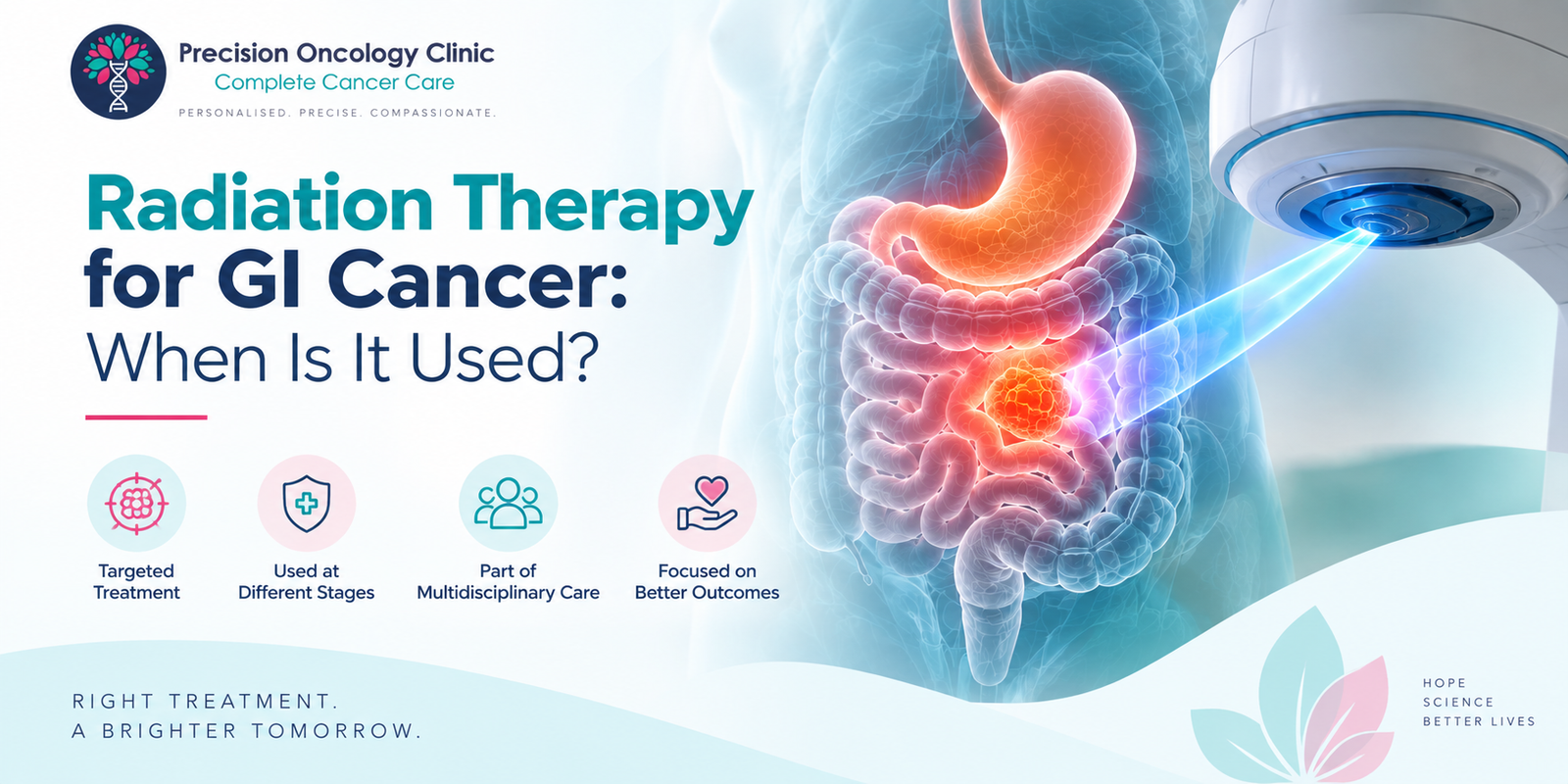
When patients hear the word radiation, one of their first questions is often:
“Will I need radiation therapy?”
The answer depends on the type of cancer, its location, stage, treatment objective and the patient’s individual circumstances.
Radiation therapy is not automatically required for every gastrointestinal cancer.
At Precision Oncology Clinic, Bangalore, Dr. S. D. Shamsundar, Consultant Radiation Oncologist, specialises in radiation oncology and precision radiotherapy. His published profile includes specialist training in Radiation Oncology and advanced fellowship training in SRS and SBRT.
What Is Radiation Therapy?
Radiation therapy uses high-energy radiation to damage cancer cells and prevent them from continuing to grow.
It can be used:
- Before surgery
- After surgery
- Alongside systemic treatment
- As a primary treatment for selected cancers
- To control symptoms in selected advanced cancers
The role of radiation varies significantly depending on the cancer.
Which GI Cancers Can Involve Radiation Therapy?
Radiation may have a role in selected cancers of the:
- Oesophagus
- Rectum
- Stomach
- Liver
- Other gastrointestinal sites
The clinic’s radiation oncology profile specifically describes radiation as an option for selected gastrointestinal cancers depending on the organ involved, tumour location and stage.
For oesophageal cancer, treatment can involve surgery, chemotherapy, radiation or combinations such as chemoradiation depending on stage and individual circumstances.
Why Is Radiation Sometimes Given Before Surgery?
In selected cancers, radiation may be used before surgery as part of a combined treatment strategy.
The purpose can include treating the tumour and surrounding at-risk areas before an operation.
Whether this approach is appropriate depends on the specific cancer and stage.
It should never be assumed that one treatment sequence applies to every patient.
Can Radiation Be Used After Surgery?
Yes.
After surgery, the oncology team may assess whether additional radiation is appropriate based on factors such as:
- Tumour characteristics
- Surgical findings
- Lymph-node involvement
- Margins
- Stage
- Risk of local recurrence
- Previous treatments
The final decision is made as part of the overall treatment plan.
What Is Precision Radiation Therapy?
Modern radiation oncology involves much more than simply directing radiation towards a tumour.
Treatment planning can incorporate:
IMRT — Intensity-Modulated Radiation Therapy
Helps shape and modulate radiation dose around the treatment target.
IGRT — Image-Guided Radiation Therapy
Uses imaging to help verify positioning and target localisation.
VMAT — Volumetric Modulated Arc Therapy
Delivers radiation through planned rotational treatment arcs.
SBRT — Stereotactic Body Radiation Therapy
Provides highly focused radiation for selected tumours and clinical situations.
Dr. Shamsundar’s published profile lists experience with IMRT, IGRT, VMAT, SRS, SBRT and brachytherapy.
Is Radiation Therapy Painful?
The radiation delivery itself is generally not painful.
However, side effects can occur depending on:
- The treatment area
- Radiation dose
- Number of sessions
- Other treatments being given
- Individual patient factors
Your Radiation Oncologist should explain the potential effects relevant to your specific treatment.
Radiation Therapy Is Part of a Larger Cancer Plan
Radiation does not always work in isolation.
A GI cancer treatment plan may involve:
Surgery → Medical Oncology → Radiation Oncology → Follow-up
or a different sequence depending on the diagnosis.
For example, treatment for oesophageal cancer can involve combinations of chemotherapy, radiation and surgery depending on stage and clinical circumstances.
This is why multidisciplinary cancer care is important.
Meet Dr. S. D. Shamsundar
Dr. S. D. Shamsundar, MBBS, MD, FAROI, is a Consultant Radiation Oncologist at Precision Oncology Clinic, Bangalore.
His published professional profile states that he completed MBBS at M. S. Ramaiah Medical College and MD in Radiation Oncology at King George Medical University, Lucknow, followed by fellowship training in SRS and SBRT.
His clinical profile includes modern radiation techniques such as:
- IMRT
- IGRT
- VMAT
- SRS
- SBRT
- Brachytherapy
Radiation treatment is selected according to the cancer diagnosis, stage, tumour location, treatment objective and surrounding organs.
Frequently Asked Questions
Does every GI cancer patient need radiation?
No. Radiation is considered only when it has a clinically appropriate role.
Can radiation be combined with chemotherapy?
Yes. Certain cancers may be treated using chemoradiation when clinically appropriate.
How is the radiation technique selected?
The Radiation Oncologist considers the cancer type, location, stage, treatment objective, previous treatment and nearby organs.
How many radiation sessions are required?
There is no single number. The schedule depends on the diagnosis, treatment objective and technique.
Can I consult a Radiation Oncologist before starting treatment?
Yes. A Radiation Oncology consultation can help you understand whether radiation has a role in your individual treatment plan.
Author / Medical Review
Medical Specialist: Dr. S. D. Shamsundar
Qualification: MBBS, MD, FAROI
Speciality: Radiation Oncology
Clinic: Precision Oncology Clinic, Bangalore
This article is for general education and does not replace an individual medical consultation.
📞 +91 95915 35454
🌐 https://precisiononcologyclinic.com/gastrointestinal-cancer-treatment/

